
The Hidden Costs of Poor Organizational Design: What Businesses Overlook
An inefficient organizational structure can quietly affect performance. Learn how better design creates clarity, efficiency, and stronger business outcomes.

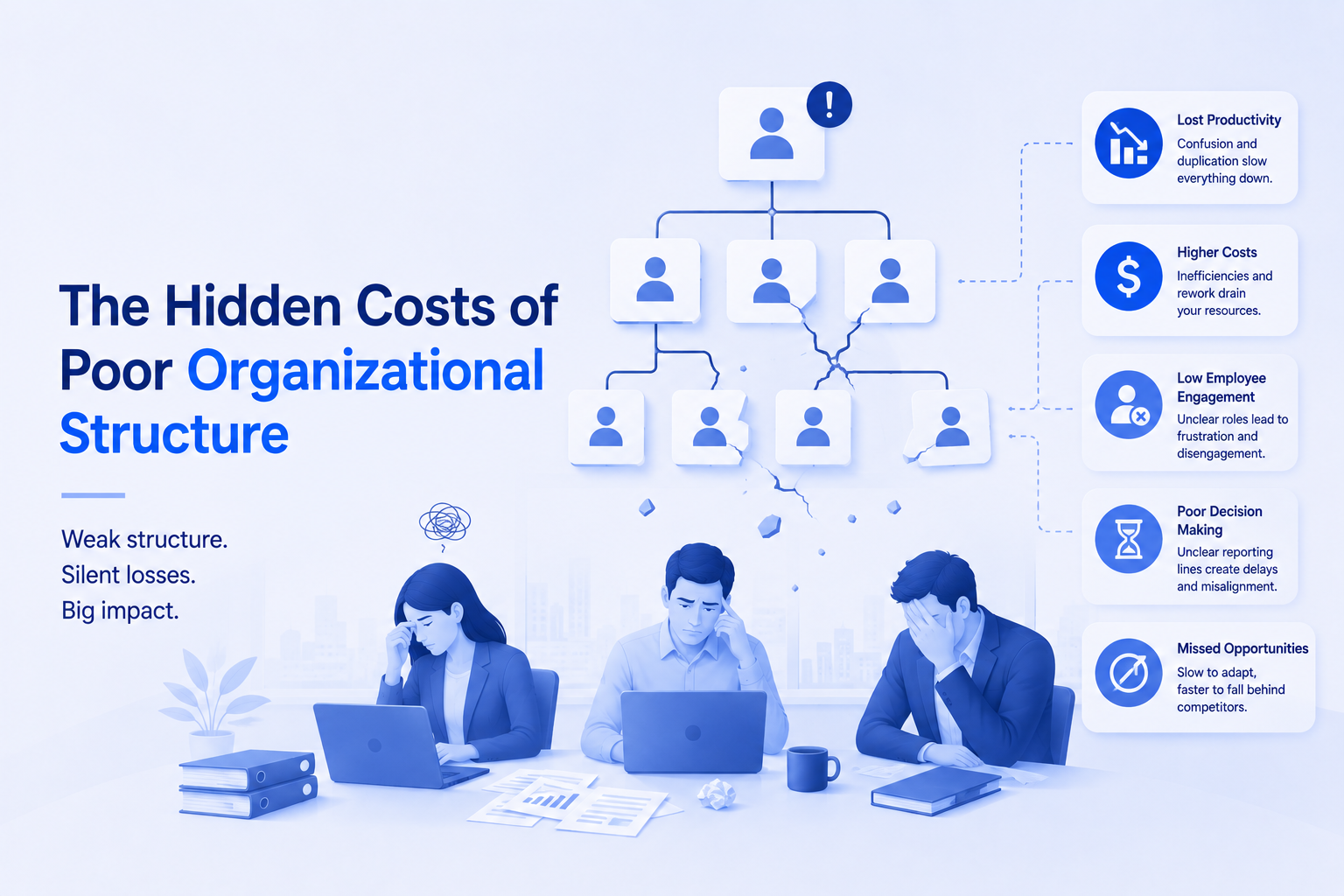
The Hidden Cost of a Poor Organizational Structure
Growth does not break performance on its own. Outdated reporting lines, decision rights and role definitions do.
Organizational Design • 2026 • 4 min read
Every leadership team has felt it. A decision that used to take a day now takes three weeks. A project stalls between two departments that both think it belongs to the other. A strategy that reads well on a slide breaks down somewhere between the boardroom and the front line. The instinct is to blame the people in the room, the process on paper, or the software running underneath it. In case after case, Procapita Group's advisory work across the region points to something else entirely. The real constraint sits one level higher, in the structure itself.
Diagnosis
When Structure Becomes a Business Problem
Organizational structure is not simply an HR matter, it is the operating architecture of the business. As a company grows, enters new markets, or shifts strategy, the reporting lines, decision rights and role definitions that once worked well can quietly become friction. Nobody redesigns an org chart on purpose to slow things down, but structures that do not evolve alongside the business tend to do exactly that.
The scale of the problem is larger than most executives assume. In McKinsey's global research on organizational health, close to 40 percent of respondents point to complex organizational structure as a leading cause of inefficiency, and a similarly sized group cites unclear roles and responsibilities as the culprit.
Source: McKinsey, The State of Organizations 2023
Cost
The Costs Organizations Do Not Always Measure
A bloated headcount line is easy for finance to spot. What is harder to quantify, and easy to underestimate, is what a flawed structure costs in duplicated effort, slow decisions and misallocated talent. Five patterns show up again and again across growing organizations.
Duplicated roles and responsibilities
Teams that grow independently end up doing the same work twice without realizing it, adding cost without adding value.
Slow decision making
Too many approval layers, or unclear decision authority, push routine calls upward instead of to the people closest to the work.
Management overhead
Narrow spans of control add unnecessary layers, slowing information flow and inflating payroll without proportional value.
Unclear accountability
Employees can describe their daily tasks but cannot say who owns the outcome, so results fall through the gaps.
Underutilized talent
Capable people are positioned in the wrong roles or levels, so real capability sits idle inside the organization.
$250M
Estimated annual cost of inefficient decision making inside a typical large organization, in lost management time alone.
72%
Of senior executives say bad strategic decisions are about as common as good ones, or the prevailing norm, inside their organization.
49%
Of employees strongly agree they know what is expected of them at work, well below the 61 percent peak measured in 2015.
Source: Gallup Workplace Research
Impact
The Impact Goes Beyond Cost
A poor structure rarely shows up as a single line on the income statement. It shows up as product launches that slip, customer experience that varies from one region to another, and a strategy that stalls somewhere between the boardroom and the front line. Employees feel the friction as ambiguity, and ambiguity is closely tied to lower engagement and higher turnover risk. For a business competing on speed, talent or customer experience, structure is either a multiplier or a drag. There is rarely a neutral setting.
Comparison
People Problem or Structure Problem
The two are easy to confuse, and leadership teams often spend months fixing the wrong one.
What It Looks Like
- Decisions keep stalling with the same manager
- One team seems to own everything
- Certain employees are constantly overloaded
- Leaders keep getting pulled into details
What It Usually Signals
- Decision rights were never clearly assigned
- Roles were never rebalanced as the business grew
- Spans of control are too wide or too narrow
- Escalation has become the default, not the exception
Design
From Organizational Structure to Organizational Effectiveness
Moving from diagnosis to design means examining the full operating model, not redrawing a few boxes on a chart.
-
1
Map the operating model
Review how many layers sit between the front line and leadership, and why each one exists.
-
2
Assess spans and layers
Check whether management ratios still match the size and complexity of the business today.
-
3
Clarify roles and decision rights
Assign clear ownership for outcomes, not just tasks, so accountability does not diffuse across teams.
-
4
Align workforce allocation to strategy
Move capability toward where the business is actually headed, not where the org chart happened to place it.
Strategy
Structure Should Follow Strategy
Redesigning a structure purely to trim headcount or simplify an org chart treats the symptom rather than the cause. The better question for any CEO, executive committee or HR leader to ask is whether the current structure enables the strategy, capabilities and priorities the business needs for what comes next. Organizations that get this right build structures that flex as they grow, instead of structures that have to be dismantled every time the business changes direction.
Is your structure built for where the business is going
Procapita Group's advisory team, alongside Zenithr AI's workforce analytics, helps organizations assess operating models, decision rights and workforce allocation, then design structures that scale with strategy.
Contact UsStatistics referenced in this article are drawn from McKinsey & Company and Gallup Workplace Research, as cited above.