

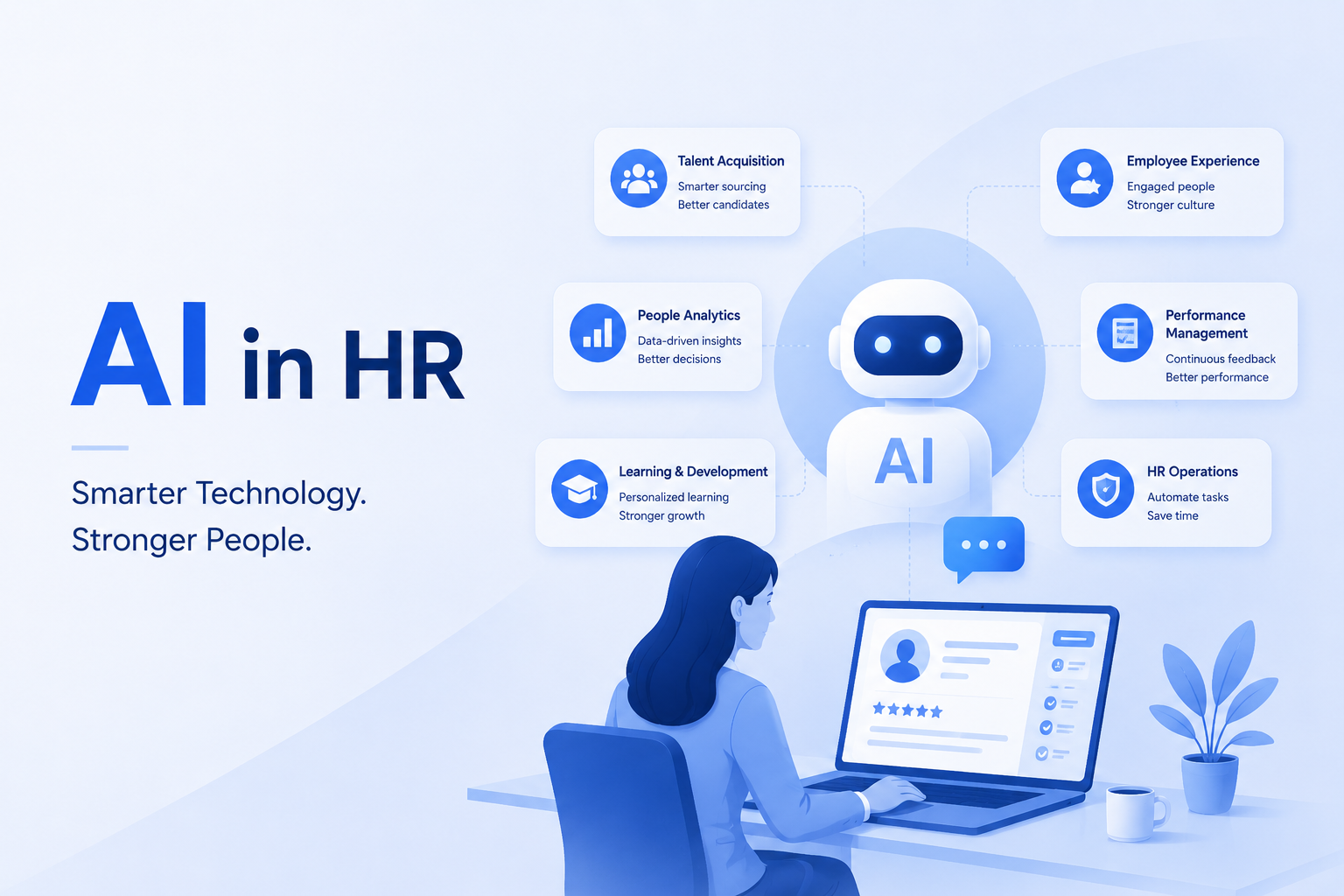
AI in HR: The Shift From Administrative to Strategic
What every HR leader in the GCC needs to understand about artificial intelligence and how to use it with confidence, backed by regional research.
Artificial intelligence has crossed from trend to operational reality across the GCC, and HR is at the center of that shift. Regional adoption has surged from 62% of organizations in 2023 to 84% by 2025, according to Procapita Group's 2026 GCC AI Intelligence Report. For HR leaders, this is not background news. It is the context in which every hiring decision, development plan, and workforce strategy is now made.
Yet investment alone does not produce results. The same research finds that up to 95% of corporate AI initiatives fail to generate measurable value, most stalling at the pilot stage. The organizations that succeed are not necessarily those with the largest budgets. They are those that pair investment with disciplined execution, clean data, and real change management. Understanding that gap is where HR's role in AI becomes critical.
What AI Actually Does in HR Without the Buzzwords
Most HR professionals do not need to understand how machine learning models work. What they need to understand is what AI changes about their daily decisions and long term strategy. At its core, AI in HR does three things: it automates repetitive, time consuming tasks; it surfaces patterns in workforce data that humans would miss; and it turns those patterns into recommendations that HR can act on. This is the foundation of people analytics, moving from gut feel decisions to evidence backed ones.
Recruitment and Screening
AI ranks candidates by role fit, flags skills mismatches early, and reduces time to hire. Critical in a GCC market where applicants per vacancy rose 80% year on year in 2025.
Workforce Planning
Predictive analytics forecast skills gaps in advance, helping HR plan hiring and restructuring before talent shortages impact the business.
Learning and Development
AI converts assessment results into personalized development plans at scale, something that previously required significant manual effort per employee.
Employee Experience
Continuous listening tools and engagement surveys analyzed by AI give HR real time signals on team morale, well being risks, and retention trends.
The GCC Context: Why This Matters Here Specifically
The GCC labor market in 2026 is defined by a rare tension: organizations are expanding headcount at the fastest pace in years, yet recruitment teams face structurally constrained qualified talent supply. Procapita's GCC Recruitment Efficiency Report 2026 shows applicants per vacancy rising from 178 to 321 in 2025, an 80.3% year on year increase. More candidates are entering the funnel, but not enough are being validated and selected at the speed business growth demands.
Specialist skills scarcity is the dominant barrier at 88%, followed by compensation expectation mismatches at 59.9%. Time to hire for technology and AI specialist roles now stands at 55 days, the longest of any sector. These are exactly the friction points where well deployed AI in HR creates measurable relief: faster screening, better candidate role matching, and earlier identification of pipeline gaps.
For organizations navigating nationalization mandates alongside these market pressures, Procapita's 2026 HR Trends analysis identifies AI powered decision making as one of the clearest competitive separators in the region this year.
Organizations with mature HR analytics capabilities generate 18% higher revenue per employee, improve productivity by 24%, and reduce turnover costs by 41%.
— Procapita Group, GCC HR Analytics and Workforce Intelligence Report 2026The Business Case Is Proven, But Execution Is Where Organizations Fail
The ROI on HR analytics is well documented in Procapita's regional research. Organizations that reach analytics maturity are not only 5x more likely to make fast, data driven decisions, they are 3.2x more likely to outperform their competitors. They generate 18% higher revenue per employee, improve productivity by 24%, reduce time to hire by 32%, and cut turnover costs by 41%. These are compounding advantages that become progressively harder for less mature organizations to close.
Yet despite 70% of GCC organizations planning to implement data driven HR solutions, three barriers remain persistent: data quality issues affect 74% of organizations, 69% report a lack of analytics skills, and 63% struggle with system integration. These are not technology problems. They are organizational readiness problems. Strategic HR management requires resolving data quality first, building analytical capability second, and connecting systems third.
AI Supports Human Judgment. It Does Not Replace It.
A recurring theme across Procapita's research is that the most effective AI implementations keep human expertise at the center. Contrary to early fears of widespread displacement, the current phase of AI adoption is driving job reallocation toward higher value activities, not elimination. As routine cognitive tasks are automated, organizations are redesigning roles and investing in upskilling.
This means HR's actual role in an AI augmented environment becomes more strategic, not less. AI surfaces the recommendations; HR professionals evaluate, contextualize, and decide. That design principle, human in the loop, is not a limitation of the technology. It is good practice, and it is what builds employee trust in the systems HR adopts.
The Bottom Line for GCC HR Leaders
The GCC's AI trajectory is clear: adoption has nearly doubled in two years, investment is accelerating toward $30 billion regionally, and the performance gap between analytics mature and analytics lagging organizations is widening. The question for HR is no longer whether to engage with AI. It is how to do it in a way that actually generates value rather than joining the 95% of initiatives that stall.
That means grounding AI adoption in regional data, building on clean HR foundations, connecting tools across the talent lifecycle, and keeping human expertise at the center of every decision. For HR teams looking to build that capability, the shift from activity driven to evidence based recruitment is where the strongest returns begin.
The Intelligence Layer Behind Talent Decisions
Zenithr, Procapita Group's talent intelligence platform, has built AI directly into the HR workflow. ZenithrAI agents automate job profiling, generate competency based assessments, convert survey data into prioritized action plans, and build personalized development plans for every employee. It maps the shifting skills landscape within an organization, identifies capability gaps before they impact performance, and delivers personalized upskilling pathways while keeping HR professionals in control of every final decision.
Explore ZenithrAI →Ready to bring AI into your HR strategy?
Procapita Group advises organizations across the GCC on building people strategies that are data driven, regionally grounded, and built to perform.
Talk to Our HR Consultants