
What GCC Board Members Are Paid: and Why It Matters More Than Ever
What do GCC board members earn in 2025? Explore compensation data, governance trends, and board diversity insights across UAE, Saudi Arabia, and the wider Gulf.

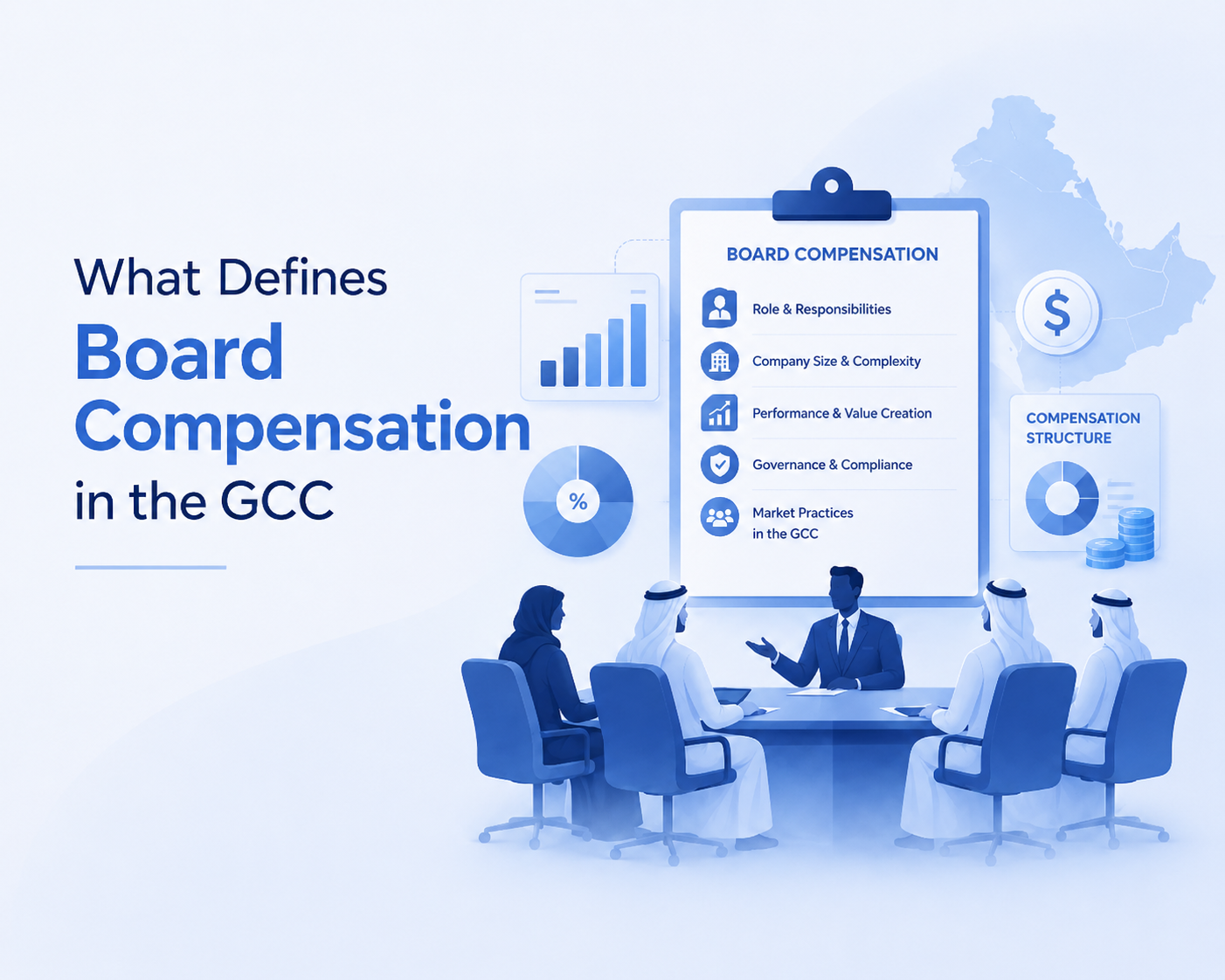
What GCC Board Members Are Paid: and Why It Matters More Than Ever
Procapita Group· May 2026· 4 min read
As GCC economies diversify away from oil, the boardroom has become ground zero for corporate strategy, investor trust, and governance reform. Understanding what board members earn and what that pay signals about a company's priorities has never been more critical for business leaders and shareholders in the region.
Boardroom compensation in the Gulf Cooperation Council is no longer just an HR number. It is a window into how seriously a company takes governance, accountability, and long-term performance. In 2024 and into 2025, the conversation around what GCC board members do and earn has intensified, driven by new regulatory frameworks, growing ESG disclosure requirements, and a push for greater diversity across boardrooms.
This article builds on that foundation with updated data, a deeper look at why compensation structures vary across GCC countries, and what the latest boardroom trends mean for businesses today.
The Numbers: What GCC Board Members Actually Earn
Board compensation in the GCC varies significantly based on country, company size, sector, and whether the director is executive or non-executive. Drawing on Procapita Group's GCC HR Trends & Practices Report 2025 to 2026, here is the most current picture across the region:
| Country | Non-Executive Director (Annual) | Tier | Key Note |
|---|---|---|---|
| 🇦🇪UAE | USD 40,000 to USD 120,000 | High | Strongest governance disclosure reform pace; leads on ESG |
| 🇸🇦Saudi Arabia | USD 30,000 to USD 100,000 | High | Vision 2030 driving governance upgrade and board diversity |
| 🇶🇦Qatar | USD 25,000 to USD 60,000 | Mid | Growing push toward mandatory ESG reporting |
| 🇰🇼Kuwait | USD 20,000 to USD 50,000 | Mid | Conservative pay structures; family-owned corporates dominant |
| 🇧🇭Bahrain | USD 25,000 to USD 65,000 | Mid | CBB enforced ESG reporting for listed companies in 2024 |
| 🇴🇲Oman | USD 22,000 to USD 55,000 | Emerging | Mandatory sustainability reporting from 2025 (MSX) |
Source: Procapita Group GCC HR Trends & Practices Report 2023 to 2025. Figures represent base retainers for non-executive directors; excludes stock options, travel allowances, and insurance benefits.
Source: Procapita Group GCC HR Trends & Practices Report 2025. Figures are midpoint estimates of disclosed retainer ranges.
For a more detailed breakdown of historical data and role-by-role analysis, see our original deep-dive: How Much Board of Directors Members in GCC Get Paid and What They Do.
What Are GCC Board Members Actually Paid to Do?
Compensation reflects responsibility and in the GCC, board responsibilities are growing. Directors are no longer simply rubber stamping executive decisions. They are expected to actively oversee strategy, manage risk, and ensure transparent reporting.
Strategic Oversight
Setting and approving long-term corporate direction, including M&A, capital allocation, and market expansion decisions.
Risk Management
Identifying financial, operational, and reputational risks and ensuring the executive team has effective mitigation plans in place.
Financial Oversight
Reviewing financial statements, approving budgets, and maintaining the integrity of financial reporting for shareholders and regulators.
Corporate Governance
Ensuring compliance with local regulatory frameworks, auditing standards, and increasingly, ESG disclosure requirements.
The demand for specialized expertise on boards is rising fast. Inclusion of independent directors with skills in digital transformation, ESG, and audit is now a stated governance priority across listed companies in the UAE and Saudi Arabia, and compensation packages are starting to reflect this premium.
Why It Matters: Governance, ESG & the Disclosure Shift
One of the most significant developments shaping board compensation in 2024 to 2025 is the acceleration of ESG-linked governance reform across the GCC. Regulators and stock exchanges are raising the bar on transparency, and board members bear direct accountability for whether their companies meet these standards.
The UAE and Saudi Arabia are leading the region with comprehensive mandatory ESG disclosure requirements for listed companies, while Qatar and Oman are progressively strengthening their voluntary frameworks toward future mandates. In 2024, Bahrain's Central Bank enforced ESG reporting requirements for listed corporations and financial institutions, covering Scope 1, 2, and 3 emissions aligned with the Global Reporting Initiative (GRI).
Rather than fixed retainers alone, many GCC companies are now introducing performance-linked bonuses or equity-based components to board packages. This shift aligns director interests with long-term shareholder value, a model well-established in global markets and gaining traction across the Gulf.
The Diversity Shift: Women on GCC Boards
Perhaps the most striking governance story in the GCC right now is the rapid, if still incomplete, rise of women in the boardroom.
Source: GCC Board Gender Index 2026, Heriot-Watt University & Aurora50. Data from 759 listed companies, 5,755 board seats as of January 2026.
According to the GCC Board Gender Index 2026 by Heriot-Watt University and Aurora50, women now hold 7% of board positions across the GCC, up from just 3.5% region-wide in 2020. The UAE leads decisively with 15% female board representation, driven in part by government mandates and public-private initiatives.
The financial sector accounts for the highest number of female board seats region-wide, followed by the industrial sector. Importantly, the UAE and Saudi Arabia are the only GCC countries where women hold board positions across every sector, a signal of more systematic rather than tokenistic inclusion.
The business case for this shift is well-established: diverse boards are associated with stronger ESG performance, better risk oversight, and more equitable pay structures within the organizations they govern.
What This Means for Business Leaders
Whether you are preparing for a public listing, attracting foreign investment, or simply looking to strengthen internal governance, the signals from the GCC boardroom landscape in 2025 are clear:
Compensation transparency is no longer optional. As the UAE and Saudi Arabia update their corporate governance codes to require clearer disclosure of board remuneration, companies that proactively align with these standards will build greater investor and stakeholder trust.
Board skills are evolving. The growing demand for directors with expertise in technology, sustainability, and international business means that competitive compensation, not legacy relationships alone, will determine who sits at your table.
Diversity is a governance indicator, not just a social goal. Boards with greater gender and expertise diversity are demonstrably better equipped to navigate the complexities of a diversifying Gulf economy.
Build a Board That Performs
Procapita Group supports organizations across the GCC in designing governance frameworks, benchmarking board compensation, and conducting board effectiveness reviews.
Talk to Our Advisory TeamSources & References
- Procapita Group, GCC HR Trends & Practices Report 2025 to 2026
- Procapita Group, How Much Board of Directors Members in GCC Get Paid and What They Do (2024)
- GCC Board Gender Index 2026, Heriot-Watt University & Aurora50: Entrepreneur Middle East
- GCC Board Gender Index 2025, Gulf Business
- ESG Reporting in the GCC, SustainGulf.org (2025)
- Central Bank of Bahrain ESG Enforcement 2024, Oren (2025)
- GCC Exchanges ESG Disclosure Landscape, Glass Lewis
- Board Gender Diversity, ESG & Executive Pay in GCC, Humanities and Social Sciences Communications, 2026
- PwC Middle East, Board Effectiveness and Governance Survey 2024: pwc.com
- Hawkamah Institute for Corporate Governance, hawkamah.org