
Compensation Benchmarking in the GCC.
GCC salaries are rising faster than most budgets. The companies that win the talent war in 2026 won't just spend more they'll spend smarter, with precise, role-specific benchmarking at the heart of every pay decision.

Compensation Benchmarking in the GCC
How to Stay Competitive in a Rising Salary Market
GCC salaries are rising faster than most budgets. The companies that win the talent war in 2026 won't just spend more they'll spend smarter, with precise, role-specific benchmarking at the heart of every pay decision.
Here is a striking paradox atthe heart of the 2026 GCC talent market: 58% of professionals received a pay increase in 2025 yet 60% say their compensation still does not match their responsibilities.That is not a pay problem. That is a benchmarking problem.
66% of employers grew their headcount in 2025, and only13% have no hiring plans for the year ahead. The competition for skilled talent is as intense as it has ever been and yet, too manyorganisations are still anchoring pay decisions to outdated surveys and annualreview cycles that move far too slowly.
This article sets out whatbest-practice compensation benchmarking looks like in 2026, what the data saysabout where salaries are heading across the GCC, and how HR leaders can build acompensation architecture that wins talent without losing budget discipline.
“In 2026, the GCC talent market is not short of money. It is short of precision.”
What the data says: the GCC salary landscape in 2026
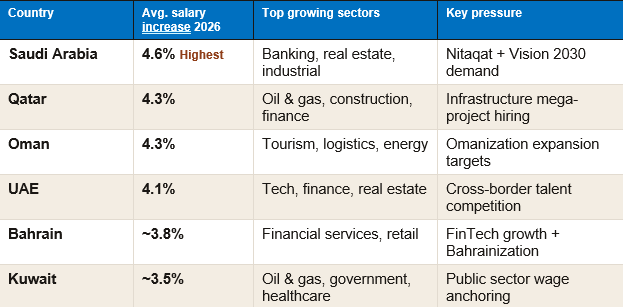
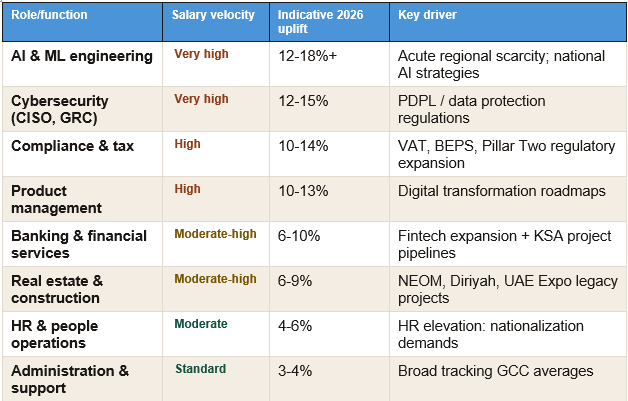
Forecasts indicate an average salary increase of 4.6% inSaudi Arabia and approximately 4.1% in the UAE in 2026 but thoseheadline figures hide far greater volatility at the role level. Specialisedpositions in AI engineering, compliance, and cybersecurity are seeing double-digit pay increases exceeding 10%,driven by acute talent scarcity.
The Hays GCCSalary Guide 2026 drawing on data for nearly 400 roles across 11sectors — confirms that the region's broader economic momentum is very muchintact. With projected GDP growth of 4.6%, the GCC is entering anew phase of transformation driven by technology, sustainability, and humancapital.
Table 1 — Projected average salary increases by GCC country,2026
Sources: VBeyond GCC Labor Market Report · Hays GCC Salary Guide 2026
The “10% Club” of specialised roles in AI, digitaltransformation, and finance is moving well past what standard annual surveyswill capture. A GCC company benchmarking its Data Science teamagainst the P50 for “Technology — GCC” is working with the wrong number.
The five benchmarking mistakes GCC companies make most
MISTAKE 01
Benchmarking once a year
Annual salary surveys reflect data collected months before publication. In high-demand sectors like AI engineering and compliance, pay can shift 8–12% within a single quarter. Quarterly benchmarking cadences are becoming standard practice among leading GCC employers.
MISTAKE 02
Benchmarking only on base salary
According to the Hays GCC Salary Guide, employees rank child education allowances, flexible working, and additional leave among their most valued benefits yet employers typically lead with basic medical cover. That gap between what employees value and what employers offer is where turnover hides.
MISTAKE 03
Using regional averages instead of role-specific data
A P50 for “Finance Manager GCC” tells you very little. A P50 for “Finance Manager Banking sector — Dubai — 8–12 years’ experience” is what you actually need. WorldatWork identifies role-level granularity as the single biggest differentiator in benchmarking quality.
MISTAKE 04
Ignoring cross-border competition
Companies cannot benchmark against local competitors alone — they are competing with Riyadh, Doha, and Muscat simultaneously. A Finance Director in Dubai is comparing offers across the Gulf, not just within the emirate.
MISTAKE 05
Treating national and expat pay as separate systems
Nationalization programs have evolved from headcount targets to wage-verified metrics. Nitaqat and Emiratization systems now use WPS and GOSI salary data to detect pay gaps between nationals and expatriates in equivalent roles. Pay equity is no longer just ethical it is a compliance issue.
Building a competitive compensation architecture
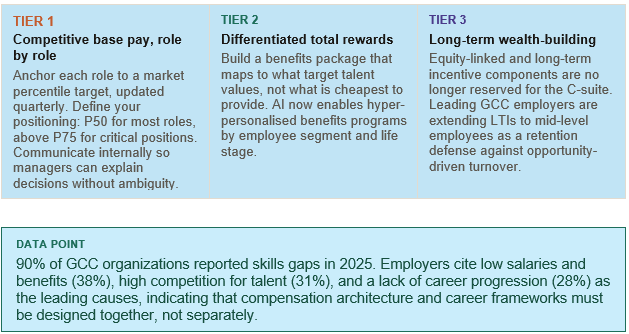
Payscale's 2026 Compensation Best Practices Reportidentifies 2026 as “The Year of Strategic Alignment”, with 68% of organisationsnow treating pay as an executive-level strategic lever. Here is what thatarchitecture looks like in practice:
DATA POINT
90% of GCC organisations reported skills gaps in 2025. Employers cite low salaries and benefits (38%), high competition for talent (31%), and lack of career progression (28%) as the leading causes — meaning compensation architecture and career frameworks must be designed together, not separately.
Salary benchmarking by sector: where pay is moving fastest
Not all roles are moving at thesame pace. The table below maps the highest-velocity salary segments across theGCC in 2026, so HR leaders can prioritise where real-time benchmarking notannual survey data is non-negotiable.
Table 2 — High-velocity salary segments, GCC 2026
Sources: VBeyond GCC Labor Market Report · Payscale CBPR 2026
Pay transparency: the quiet shift reshaping GCC compensation
49% of organisations globally are now targetingorganisation-wide pay transparency in 2026 a sharp rise from athird of organisations just one year ago. The GCC is moving at its own pace,but the direction is consistent: regulators, employees, and investors are allapplying upward pressure.
The UAE’s updated labour lawintroduced equal pay provisions for equivalent roles. Nitaqat now uses WPS andGOSI data to surface pay gaps between Saudi nationals and expatriates. Theseare present realities that a well-structured compensation audit will surfaceand resolve before they become liabilities.
In practical terms for GCCemployers, this means:
✓ Conducting an internal pay equity audit by role, level, gender,and nationality
✓ Defining and documenting a job architecture grades, bands, andlevelling criteria so any pay decision can be explained
✓ Training line managers to communicate pay decisions withconfidence, not ambiguity
✓ Producing total rewards statements for each employee that makethe full package value visible not just base salary
The compensation benchmarking audit checklist
Use this checklist to assesswhere your organisation stands before your next salary review cycle:
✓ Salary data reviewed at least quarterly for high-velocity roles(AI, compliance, digital)
✓ Benchmarks sourced at role, level, sector, and city level — notregional averages
✓ Total rewards package mapped against what target employeesegments actually value
✓ Cross-border salary intelligence in place for roles where talentis regionally mobile
✓ Pay equity analysis completed across national / expatriatecohorts in equivalent roles
✓ Job architecture documented with salary bands and levellingcriteria per grade
✓ Long-term incentive components reviewed for extension tomid-level talent
✓ Managers equipped with pay communication guidance for reviewconversations
When to bring in a specialist
Internal benchmarking serveswell for stable, well-defined roles where your HR team has deep familiarity.But there are four situations where a specialist adds material value:
Multi-country operations— when you need consistent, comparable data across UAE, KSA, Kuwait, and Jordansimultaneously, with each country’s statutory components built in correctly.
Nationalization pressure— when the gap between your national and expatriate pay structures needs to bediagnosed and restructured before it surfaces as a Nitaqat or Emiratizationliability.
Rapid headcount growth —when hiring velocity outpaces the HR team’s ability to validate every offer,leading to pay compression and internal equity issues downstream.
Retention crisis — whenexit data signals pay as a driver of turnover, but the business cannot identifywhere specifically the gap sits without independent analysis.
Organisationsthat fail to bridge the gap between employee salary expectations and their ownbudget constraints face a significant flight risk losing key talent to competitors who get the value proposition right.
Get a compensation benchmarking audit for your GCC operations
Procapita's advisory team works across UAE, Saudi Arabia, Kuwait, and Jordan to help organisations align pay strategy with market reality role by role, country by country.
Speak to an advisor → pro-capita.com/contact
SOURCES
Hays GCC Salary Guide 2026 · VBeyond GCC Labor Market TransformationReport · Payscale Compensation Best PracticesReport 2026 · WorldatWork — Compensation Benchmarking · HRSoft — Compensation Trends 2026 · Dubai Chronicle — GCC Salary Guide 2026